


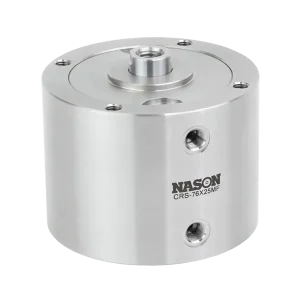


Choosing the right hydraulic cylinder is more than matching a bore size to a spec sheet. It takes a clear understanding of how force, stroke, pressure, and mounting work together in your specific application.
Get the selection right, and your equipment will run for years with minimal downtime. Get it wrong, and you may face premature failure, safety concerns, and costly redesigns that affect both your budget and your timeline.
This is the third installment in Nason’s buying-guide series. If you’ve read our vacuum switch selection guide or pressure switch selection guide, you already know our approach. We focus on the specifications that matter, the pitfalls that disrupt good designs, and the questions worth answering before choosing any component.
How does a hydraulic cylinder work?
A hydraulic cylinder operates by converting fluid pressure into mechanical force to create linear motion. By allowing fluid to enter the chamber and build pressure against a piston, the piston rod can extend or retract to produce motion.
The force output depends on bore diameter and system pressure. Larger bores generate more force, and higher pressures increase force as well.
Inside the cylinder, several components work together:
- Cylinder barrel houses the internal components
- Piston and piston rod create the motion
- Seals and bearings maintain fluid integrity and reduce friction
- End caps close the cylinder and provide mounting points
- Ports allow fluid to flow in and out
There are two primary cylinder types:
Single-acting cylinders use hydraulic pressure to extend the rod, and an external force such as gravity or a spring retracts it. These are ideal when you only need powered motion in one direction, such as in dump beds, simple lifts, or applications where gravity manages the return.
Double-acting cylinders use hydraulic pressure for both extension and retraction and provide controlled motion throughout the full stroke. These are essential when precision matters in applications like industrial presses, positioning systems, and any situation where accuracy is expected.
Hydraulic cylinders vs. pneumatic cylinders
Hydraulic cylinders deliver significantly more force in a compact package. They provide accurate positioning, consistent load holding, and precise speed control. Pneumatic cylinders tend to be cleaner, simpler, and often more cost-effective for low-force applications. They can also run at high speeds with lighter loads.
So when should you choose hydraulics? High force requirements are the main deciding factor. Anything above 1,000 pounds of force typically requires hydraulics. Pneumatic systems usually operate around 100 PSI, which limits a 2-inch bore cylinder to roughly 314 pounds of force. That same 2-inch bore running at 3,000 PSI hydraulics produces 9,420 pounds. Hydraulics also excel when you need precise position control and slow, controlled motion. And when space is tight, hydraulics provide maximum power in minimal footprint.
Real-world application examples
Hydraulic cylinders show up across a wide range of industries. Here are some of the most common applications:
- Compact construction equipment needs high force in tight spaces. Mini excavator arms, skid steers, and other mobile machines depend on strong push and pull performance without oversized components.
- Industrial presses rely on controlled speed, accurate positioning, and reliable high-force output for processes like stamping, forming, or assembling parts.
- Material handling systems commonly use cylinders for lift gates, dock levelers, and conveyor height or angle adjustments.
- Agricultural equipment requires durability under harsh conditions. Loader arms, steering assists, and implement controls must withstand dirt, weather, and heavy use.
- Automotive manufacturing uses cylinders for assembly fixtures, stamping operations, and precise part positioning. These systems depend on predictable and repeatable motion with high cycle counts.
Key factors to consider when choosing a hydraulic cylinder
Selecting a hydraulic cylinder involves balancing a lot of variables. This guide walks you through the key requirements so you can zero in on the component that truly fits your application.
Force requirements
Calculate the push and pull force your application needs. This includes load weight, friction, safety margins, and operating angles.
For example, pushing a 2,000-pound load horizontally might require only about 10% more force for friction. Lifting that same load vertically or pushing it up an incline increases the required force significantly.
Stroke length
Determine the travel distance of your load and check the available space. Retracted length is often much longer than the stroke. A cylinder with a 24-inch stroke may need a retracted length of 36 inches or more. Make sure both extended and retracted lengths fit within your installation space.
Operating pressure
Match the cylinder rating to your hydraulic system:
- 500 PSI – standard duty
- 2,000 PSI – medium-duty industrial
- 3,000 PSI – heavy-duty, high-force
Account for pressure spikes. A system operating at 2,000 PSI but occasionally reaching 2,500 PSI needs a cylinder rated to handle that range. Higher pressure ratings also allow smaller bores for the same force output.
Mounting configuration
Mounting influences alignment and load distribution. Common options include clevis, trunnion, flange, and pivot mounts. Incorrect mounting can lead to side loads that damage seals and bearings.
Rod size and configuration
Rod diameter affects buckling resistance and bearing capacity. Long strokes combined with small rods are especially prone to buckling. Choose between single- or double-rod configurations, which are useful for through-mounting or dual-sided actuation.
Seal material and type
Choose a seal material that matches your fluid and operating conditions. Buna-N works well with petroleum-based fluids and temperatures from – 40 degrees F to 250 degrees F. EPDM is the right choice for water-glycol fluids, and Viton handles high-temperature synthetic fluids. Polyurethane offers excellent wear resistance for demanding applications. Using the wrong seal material can lead to swelling, cracking, or leaks.
Speed and cushioning
Cycle time matters. If the cylinder operates at high speeds, consider cushioning to avoid end-of-stroke shock loads. Cushioning slows the piston before the end of travel to protect components and reduce noise.
Environment and duty cycle
Indoor and climate-controlled environments differ from outdoor, agricultural, or mobile applications. Consider contaminants, wash-down conditions, and temperature extremes.
Duty cycle is equally important. A cylinder used 10 times per day has different requirements than one used 10,000 times per day.
Space constraints
Measure available space carefully. Compact or mini hydraulic cylinders may be required when space is limited. Remember to include rod-end and cap-end clearance.
Common selection pitfalls and how to avoid them
Knowing what to look for is only half the battle. Just as important is knowing what mistakes to avoid. Keep an eye out for these potential issues:
- Undersized bore diameter – Always add safety margins for friction, angles, and real-world variations.
- Ignoring buckling – Long strokes with small rods can fail quickly. Use buckling charts.
- Incorrect mounting – Misalignment creates destructive side loads.
- No cushioning in high-speed applications – This leads to shock, seal damage, and noise.
- Seal incompatibility – Choosing the wrong material results in leaks and premature failure.
- Insufficient stroke – Measure carefully and allow room for mechanical stops.
- Ignoring space constraints – Confirm both extended and retracted lengths.
- Pressure mismatch – Underrated cylinders are dangerous and oversized cylinders add unnecessary cost.
Why choose Nason for hydraulic cylinders?
We manufacture hydraulic cylinders in our South Carolina facility with a focus on compact designs, fast turnaround, and customization without premium pricing. Whether you need one prototype cylinder or a thousand production units, we build cylinders to fit your design rather than forcing your design to fit our cylinders.
We offer five hydraulic cylinder series to match your pressure and performance requirements:
- L Series (500 PSI, 20mm to 76mm bore) – standard duty, low friction with nitrile seals and PTFE-impregnated grease
- L15 Series (1,500 PSI) – compact, long-lasting, low-friction performance
- L20 Series (2,000 PSI) – medium-duty industrial, available in single or double rod with inch or metric options
- L30 Series (3,000 PSI) – heavy-duty, high-force, low-profile designs
- NFPA Series (1,500 to 3,000 PSI) – precision-machined bores, floating bearings, and drop-in compatible dimensions
What sets us apart?
- Compact, low-profile designs – Our cylinders deliver strong performance in a smaller footprint, which matters when installation space is limited.
- Customization without premium pricing – Custom bores, strokes, mountings, port locations, and rod configurations in both inch and metric options come standard.
- No minimum order quantities – Order one cylinder for prototyping or a thousand for production.
- Fast USA-based manufacturing – Many orders ship in 3 to 5 business days.
- Online configurator – Design your cylinder and download instant CAD models and datasheets.
- Direct engineering support – Talk to experts who understand real-world applications.
Ready to find the right fit? Visit our hydraulic cylinder page or try our free configurator to design a custom cylinder and download CAD files. At Nason, we’re committed to helping you find the perfect match.
Frequently asked questions
What is the difference between single-acting and double-acting cylinders?
Single-acting cylinders use hydraulic pressure for one direction and an external force for the return. Double-acting cylinders use hydraulic pressure for both extension and retraction.
How do I prevent cylinder buckling on long strokes?
Select the correct rod diameter, use proper mounting to avoid side loads, and consult buckling charts. When in doubt, choose a larger rod or add intermediate support.
Can Nason provide custom stroke lengths and mounting configurations?
Yes. Custom configurations are our specialty, and there are no minimum order requirements or premium pricing.
What seal materials does Nason offer?
We offer Buna-N, Viton, and polyurethane to match your fluid and temperature needs. Our engineers can help you select the right option.
How do I choose between 500 PSI, 2,000 PSI, and 3,000 PSI cylinders?
Match the cylinder rating to your system pressure with a safe margin. For example, a 1,500 PSI system with spikes up to 1,800 PSI should use a 2,000 PSI cylinder. Higher pressure ratings let you use smaller bores for the same force, which helps reduce overall size.

 FOLLOW US ON LINKEDIN